A new architecture serving a new arrangement of collaboration. By 2031 the leading enterprises will run on three facts: execution is cheap, context is dear, and every action can be proved. Agents carry the proof. People carry the context, the judgement and the reasons. As a 2021 version of this argument put it: businesses should be boring; experiences should be interesting. This is a projection of that stable state, five years out: who does what, on which screens, with what energy, under which contracts.
The manifesto
Twelve theses. Each is a design rule, and the rest of this document shows where it lands.
- Execution is cheap; context is dear. Code, copy, analysis and routine decisions now cost little. What a person knows of a customer, a shop floor or a town, and cannot write down, costs a great deal. The enterprise invests in context, not capacity.
- People are principals; agents hold mandates. Every agent acts under a person’s signed, scoped and expiring authority. A mandate states the objective, the limits, the budgets and the duty to report, in a form people and machines both read.
- Proof replaces inspection. Actors report continuously, and sign what they report. Overseers judge the whole trajectory and answer back. A few spot checks remain, to audit the stream itself. A verdict is not only true or false: a condition can be proved, violated, unknown or inconsistent, and each gets its own response.
- Declare before you deviate. An exception declared in advance is judged on its merits. One explained afterwards is investigated. Every mandate carries an exception budget.
- Every claim has a counterparty. Records are double-entry across firms: what one party reports, another confirms. This is how a self-reporting agent is kept honest.
- The overseer gets the predicate, not the data. Regulators, auditors and partners receive proof that a condition held, not the raw records behind it.
- Memory belongs to the person it describes. Customers, employees and citizens hold the keys to what the enterprise remembers about them, and can take it with them.
- Three budgets, not one. Every mandate spends money, energy and human attention, and accounts for all three.
- The product answers for its whole life. Each product carries a passport from mine to second life. The maker remains accountable for its materials after the sale.
- Screens are for judgement, made for each person. People see intent, effect and exceptions. They do not click through workflows that agents can run. Each interface is generated for the person and the decision in front of them, not drawn once for an average user.
- The enterprise improves with every model release. Models are swappable parts. The lasting assets are mandates, evaluations, memory, clean data and the record of failures.
- Heard, not seated. The people who hold context are heard where decisions are made: engineers with clients, workers with designers, citizens with regulators. Design is the user’s ally: it earns the user’s trust rather than deciding what is good for them.
Why now: trust has moved four times
Each time the arrangement of work changed, the reason one party trusted another changed with it. The fourth move is under way.
| Period | What the client trusted | How it checked | Unit of sale |
|---|---|---|---|
| 1973 to early 1990s | People it could see | Supervised them at its own site | Programmer on site |
| 1990s to mid 2020s | Certified process | Assessments such as CMM Level 5 (Infosys, December 1999) | Person-month |
| From 2026 | Knowledge of its business | Intent defect rate, team continuity, time to an accepted requirement | Named team, priced for context |
| Around 2031 | Proved conduct, plus known people | Signed mandates, continuous reports, confirmation by counterparties | Outcome delivered under a mandate |
Lewicki and Bunker described trust that grows from weighing losses, to knowing the other side, to identifying with its intentions. A signed mandate makes that third stage checkable: both sides can read what the agent was meant to achieve and see whether it did.
In 1999 Hansen, Nohria and Tierney found that professional firms must choose between codifying knowledge and passing it person to person, and that firms trying both damaged each. The new enterprise splits the two by actor rather than by firm. Agents do the codified work. People do the person-to-person work. That is a proposition to test, not a finding.
Where this began: the 2021 lines
Much of this manifesto was sketched in a 2021 deck, The Future of UX and AI-driven Opportunities, before large language models made it practical. Its opening claim was that user experience is too important to leave to designers. By 2031 that is literally true: mandates, governors and ledgers shape what people experience as much as screens do.
| 2021 idea | What it becomes by 2031 | Where it lands here |
|---|---|---|
| Data moves from standalone, fixed-event, closed loops to networked, multiple-event, open loops | The two-way event mesh joining agents, governors, partners and the state | Architecture |
| Line of Visibility, Line of Reason (tacit) and Line of Decomposition | The same blueprint, extended with a Line of Intent and a Line of Proof | Architecture |
| Known-knowns (template UI, rules, stereotype assumptions) against new behaviours, anticipatory interfaces and agent determinism | Rules stay where they work; AI judgement handles new behaviour; declared intent keeps agents predictable | Theses 3 and 4 |
| Bounded rationality: thresholds and fast, frugal heuristics as guardrails against brittle systems | Fixed limits checked in milliseconds, AI judgement in minutes, independent audits in days | Architecture |
| TRUE, FALSE, NULL, INCONSISTENT, UNDEFINED; noisy data or “mystery data” | Verdicts of proved, violated, unknown and inconsistent; mystery data prompts curiosity, not rejection | Thesis 3 |
| Rethinking error handling: rigid rules against machine conjecture | The toll-road shift from point checks to judged trajectories | Theses 3 and 4 |
| Mooney images: people read fuzzy faces fast, machines read volumes of portraits | Agents do the codified work, people the tacit work | Why now |
| The user as a manipulable entity; design as the user’s ally that secures trust | Anyone who faces an agent has an agent of their own | The human actor |
| The product as a container that adapts its interface and content to each user | Interfaces generated for each person and each decision | Thesis 10; Screens and devices |
| Freeup: ask the machine who the experts are; intangible value frees human capacity to reimagine scale | Organisational memory shows who holds context; attention is a budget | The human actor; Operating environment |
| Supply and demand moving from analog to digitised to digital; closed, partly open, digitally open; push to pull | Open networks where buyers’ agents and sellers’ agents meet | The five contracts |
| The right digital fit: learning over knowledge, adapting over conforming, making over training, nearshore over offshore | Context workers placed with clients; named teams paid for continuity | The human actor |
| “Guardrails are not inanimate, but people” | Every governor agent has a named human owner | Running it |
“Nearshore over offshore” anticipated by five years the shift the 2026 visa rules forced on Indian IT. The deck’s open question, how to engage people beyond visible appearance and display controls, is answered below the line of visibility.
The human actor, role by role
In every role, people move from doing the steps to setting intent, holding context and signing for consequences. One rule keeps this from becoming dystopian: anyone who faces an agent has an agent of their own. The buyer’s agent works for the buyer, the worker’s for the worker, the citizen’s for the citizen.
| Role | What the person does | What agents do | What the person signs | Main devices | What protects them |
|---|---|---|---|---|---|
| Producer: factory worker, farmer, artisan | Tends the work, handles what machines cannot, corrects robots | Plan the run; call the person when stuck; log each call as training data | Batch release; safety stop | Glasses, earbud voice in their own language, watch | Each resolved escalation is recorded as their contribution |
| Seller | Holds relationships, reads the room, negotiates exceptions | Answer buyers’ agents; quote; check stock and credit across the mesh | Discounts and terms outside the mandate | Phone, earbuds, laptop | A contact ledger stops agents over-contacting customers in their name |
| Planner | Sets objectives and limits; chooses among scenarios; writes mandates | Simulate scenarios; negotiate across domains, such as stock against promotion | Mandates and budgets | Large desktop, shared wall screen | Every plan records who asked for what, and why |
| Context worker: engineer, designer, analyst | Learns the client’s work at first hand; writes requirements and evaluations; judges output | Write and test code; search the joint requirements record | Accepted requirements; evaluation suites | Laptop; glasses on site | Named in the contract and paid for staying |
| Buyer: household or procurement | Decides what is worth having; sets limits | Compare, negotiate and pay within a spend mandate; read product passports | Purchases above the limit, by biometric | Phone; TV for household decisions | Their agent and their memory work for them, not the seller |
| User | Uses the product; says what fails | The product’s agent reports condition, books service, installs updates | Consent for what the product reports | Phone, voice, the product itself | The product reports conditions met, not the user’s life |
| Installer and servicer | Installs, diagnoses, repairs | Bring the product’s history, parts and a remote expert | Work done; safety certificate | Glasses, phone | Right to repair; open diagnostics |
| Dismantler and recycler | Takes apart safely; grades materials; chooses second life | Read the passport for chemistry and hazards; find buyers for recovered material | Material recovery record | Glasses, handheld scanner | Hazards known before the first cut |
| CXO | Sets the enterprise mandate; chooses where to compete on context; spends attention; answers for outcomes | Run the governors; keep the continuous ledger; draft trade-offs | The enterprise mandate and top delegations | Desktop, phone | Signed delegations show exactly what they authorised |
| Board and shareholders | Approve the mandate and risk appetite; judge the CXO; oversee the governors | Report continuously; disclose by predicate | Risk appetite; the CXO’s mandate | Desktop, tablet | The same ledger management reads |
| Employee and community | Shape the mandate’s limits: safety, local work, emissions | Their own agents read disclosures and raise concerns | Consent for data about them | Phone | Memory about them is held under their keys |
| Government watcher: regulator, auditor, inspector | Writes machine-readable rules; investigates exceptions; judges disputes | Receive proofs; flag anomalies; sample independently | Rulings and rule changes | Desktop; glasses for field inspection | Sees conditions proved, not citizens’ raw data |
Two people from the HBR essay, five years on. The engineer from Avinashi now spends a quarter of each year in her client’s stores and warehouses. She writes the requirements and the evaluation suites, and the agents write the code. Her name is in the contract, and her client pays more to keep her. The merchandising manager in Lakeland no longer fills in shelf-layout spreadsheets. She writes the replenishment agent’s mandate, approves its declared exceptions before a hurricane, and teaches the vendor’s engineers what her stores know.
One battery’s life in 2031
Follow one electric-scooter battery through its whole life, and the architecture becomes concrete. The battery is the vehicle in the toll-road note: it reports throughout its life, and each party receives the proof it needs and nothing more. The EU already requires a digital passport for such batteries from February 2027, so this is close to the present.
| Stage | People who act | What agents do | What the passport records | What is proved, and to whom |
|---|---|---|---|---|
| Mine and refine | Miners, metallurgists | Schedule energy-heavy steps for when clean power is available; trace origin | Source of lithium, nickel and cobalt; energy and carbon per kilogram | To the buyer and regulator: due-diligence conditions met, without supplier price lists |
| Make cells and pack | Line workers, quality engineers | Run the line; call a person on each defect they cannot resolve | Chemistry, rated capacity, factory, energy used | To the scooter maker: specification met |
| Distribute | Logistics planners, drivers | Route by load, charging and clean supply | Chain of custody; temperature | To the insurer: handled within safe limits |
| Sell | Seller | The seller’s agent and the buyer’s agent negotiate price and warranty | Warranty terms; price | To the buyer: sales claims match the passport |
| Purchase | Buyer | The buyer’s agent pays within its spend mandate after checking the passport | Transfer of ownership | To the lender: payment made |
| Install | Technician or swap-station attendant | Check compatibility and run safety tests | Installation certificate | To the insurer: fitted correctly |
| Use | Rider | The battery’s agent charges when power is cheap and clean, and reports health | State of health; charge cycles | To the rider: health and remaining value. To the maker: failure patterns, not trips taken |
| Service | Servicer | Diagnose from the battery’s history; order parts | Repairs; replaced modules | To the warranty provider: repair within terms |
| Second life | Reseller, homeowner | Grade remaining health; match it to home or shop storage | New owner; new use | To the new owner: remaining capacity |
| Dismantle | Dismantler | Show hazards and the disassembly sequence before the first cut | Modules recovered | To the regulator: safe handling |
| Recycle | Recycler | Grade recovered material; sell it back to cell makers | Recovered quantities by element | To the regulator and maker: recycled-content and recovery targets met |
A T-shirt from the knitwear cluster around Tiruppur, next to Avinashi, follows the same pattern with fewer stages: fibre, spinning, knitting, dyeing, sewing, sale, wear, repair, resale and recycling back to fibre.
The operating environment
The target is protopia, Kevin Kelly’s word for a world that is slightly better each year, while each advance brings new problems. Picture Blade Runner’s density of machines, in daylight. Every mandate in this world spends three budgets, and accounts for each.
| Budget | Unit | What each mandate states | Example |
|---|---|---|---|
| Money | Currency per outcome | Spend limit; price per outcome, not per hour | ₹40 lakh a month for paid media, judged on new-customer revenue |
| Energy | Kilowatt-hours and carbon per outcome | Energy limit; which work may wait for clean power | Overnight analytics run when solar or wind supply is high |
| Attention | Minutes of human judgement per week | How often the agent may interrupt people, and whom | No more than 20 minutes a week of the planner’s time |
Energy is a real cost, so it is budgeted. The IEA estimates that data centres used about 415 TWh in 2024, around 1.5% of the world’s electricity, and projects about 945 TWh by 2030. The new enterprise therefore:
- Reports energy per outcome: per resolved ticket, per unit made, per sale.
- Routes work by energy as well as cost and quality, running small models on the device when they are good enough.
- Moves flexible work, such as analytics, training and energy-heavy production steps, to hours of clean and cheap power.
- Records the energy embodied in each product in its passport, so repair and reuse can be compared with replacement.
- Measures, rather than assumes, the savings agents create in the physical economy: fewer empty truck miles, less overproduction, longer product lives.
Attention is the scarcest budget. An agent that escalates too often spends people’s attention as surely as an agent that overspends money. Governors tune escalation thresholds against each person’s attention budget, and nothing interrupts a person that an agent can settle within its mandate.
What the places look like in 2031:
- Factory: robots work alone and call a person when stuck. Workers wear glasses that show the robot’s intent, and each call they resolve teaches the next robot.
- Store: agents restock and price. Staff act as hosts and advisers. Buyers’ agents do routine shopping online, and people come in person for advice, trial and pleasure.
- Home: appliances shift their use to cheap, clean hours. A scooter battery in its second life stores rooftop solar.
- Road: vehicles report to the authority at intervals, as in the toll-road note, and prove that average speed stayed within limits, with declared exceptions. Fixed cameras become rare auditors.
- Office: fewer screens and more conversation. Planners and leaders work at large displays where they read trajectories and sign mandates.
Screens and devices to 2031
By 2031 the most common interface will be none at all: agents act, and people hear only about exceptions. The phone stays the hub because it holds the keys. Glasses grow at work. Holograms do not arrive at scale.
| Device | Role in 2031 | Who uses it most | Confidence by 2031 |
|---|---|---|---|
| No screen (ambient) | Agents act within mandates; people hear only exceptions | Everyone | High |
| Smartphone | Holds passkeys, wallet and memory keys; approves by biometric | Everyone | High |
| Earbuds and voice | Main channel to agents, in the person’s own language | Field workers; India’s voice-first users | High |
| Smartwatch and ring | Presence, health, one-tap approval of a declared exception | Workers, managers | High |
| Laptop and large desktop | Writing mandates and evaluations; reading trajectories; deep work | Planners, context workers, CXOs, regulators | High |
| Smart glasses with display | Show an agent’s intent in the field; remote expert; record work with consent | Producers, servicers, inspectors | Medium |
| Home TV and shared wall screens | Household budgets and purchases; team decisions | Households, teams | Medium |
| Mixed-reality headsets | Design reviews, training, digital twins of plants | Designers, trainers, engineers | Medium |
| 3D light-field video | Remote presence for high-stakes meetings | Boards, executives, specialists | Low |
| Immersive venues (4D) | Simulators, flagship retail, entertainment | Trainees, visitors | Low |
| Free-standing holograms | Not practical at scale within five years | Demonstrations | Low |
3D video already exists: HP’s Dimension with Google Beam went on general sale in September 2026, at about $25,000, in six countries. At that price it serves boardrooms, not homes, through 2031.
The rule for choosing a device: match the device to the decision, not to the novelty. Signing needs the root of trust, so it happens on a phone or watch. Writing a mandate needs room, so it happens on a large screen. Field work needs free hands, so it happens through voice and glasses.
The architecture: the 2021 blueprint, extended
The architecture is the 2021 service blueprint with two more lines. The Line of Intent separates what people want from how it is known and done. The Line of Proof separates what agents do from what others can confirm.
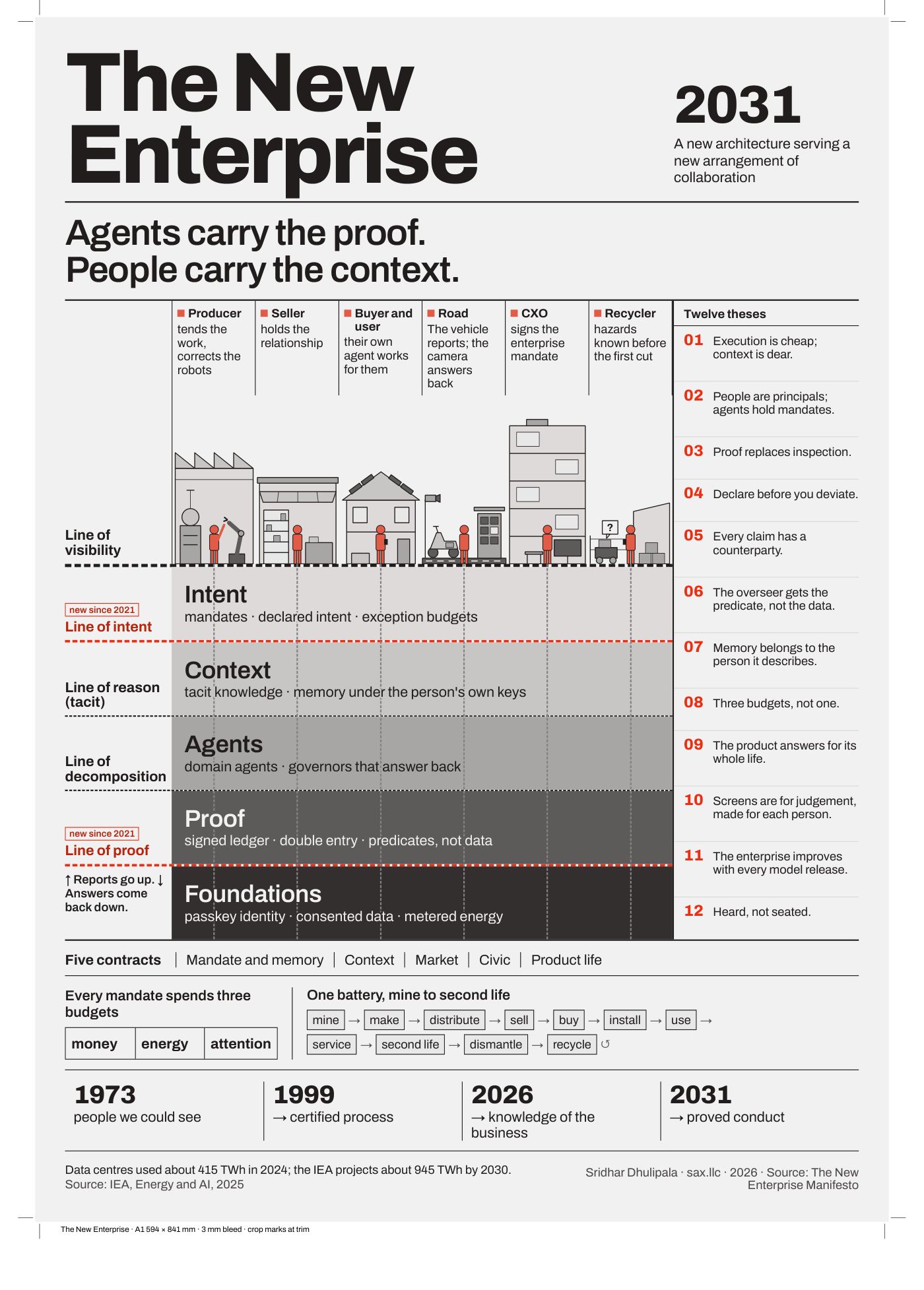
Everything above the line of visibility is generated for each person. Everything below it reports upward and can be answered from above. The same lines run through five rings, each joined to the next by two-way exchanges:
- Person and enterprise: mandates flow down; consent and the keys to personal memory stay with the person.
- Enterprise and enterprise: agents negotiate across firms, and each confirms what the other reports.
- Enterprise and market: buyers’ agents and sellers’ agents meet on open networks. India’s ONDC is an early example.
- Enterprise and state: the state publishes rules as code; the enterprise answers with proofs that the rules held.
- Enterprise and planet: passports and energy ledgers account for materials and power from extraction to recovery.
Governors work at three speeds, as the 2021 deck’s bounded rationality suggested. Fixed thresholds stay where speed matters and are checked in milliseconds. AI judgement of trajectories takes minutes. Independent audits by sampling take days.
The five contracts of the new arrangement
The new arrangement of collaboration is five contracts, one for each ring. Each one already has a working seed today.
| Contract | Between | What it binds | How it is kept honest | Seed already visible |
|---|---|---|---|---|
| Mandate and memory | Person and enterprise, and the person’s agents | Objective, limits, three budgets, exception budget, reporting duty, expiry; what is remembered, under whose keys | Governors check every action; the person can revoke at once and take their memory with them | Passkey smart wallets with session keys; India’s Account Aggregator consent artefacts |
| Context | Client and vendor, or enterprise and its own context workers | Named people, pay for continuity, a joint requirements record, credits above an agreed intent defect rate | Both sides classify defects together each month and count disagreements separately | The terms proposed in the HBR essay |
| Market | Buyers’ agents and sellers’ agents | Price, terms and claims checked against product passports; spend mandates | Double entry between the two agents and the payment rail | ONDC; UPI; agent payment protocols such as AP2 and x402 |
| Civic | Enterprise and state | Rules published as code; proofs that they held; declared exceptions | Independent random audits; counterparty confirmation | GST e-invoicing, which replaced periodic checks with real-time reporting |
| Product life | Enterprise, future owners and the planet | Passport, take-back, recovery targets, energy per outcome | Recyclers and regulators confirm recovered quantities | EU battery passports, required from 18 February 2027 |
In the 2021 deck, the most open stance was “digitally open”: a collaborative platform that lets go of control. These contracts make that stance safe. Control is given up over how the work is done, and kept over what may be done and what must be proved.
Running it: the CXO, the board and the numbers
The CXO’s job narrows to five decisions, each signed: the enterprise mandate, where to compete on context, who holds which delegation, how human attention is spent, and which escalations reach the top.
Shareholders and stakeholders read the same ledger. Shareholder returns are the objective. Stakeholder interests, such as safety, local work, emissions and privacy, are the signed limits on how the objective may be reached, not aspirations in an annual report.
The board oversees the governors. As the 2021 deck put it, guardrails are not inanimate, but people: every governor agent has a named human owner who answers for its thresholds and its misses.
| Measure | What it shows | Who watches it |
|---|---|---|
| Intent defect rate | Share of defects caused by a misread requirement, not by wrong code | CXO and client |
| Context continuity | Share of named people still in their domain or account after a year | CXO, people function |
| Time to context | How long a new person takes to write a requirement accepted without rework | Delivery heads |
| Declared deviations | Share of deviations declared before they happened | Board risk committee |
| Confirmed actions | Share of agent actions confirmed by a counterparty | Auditors |
| Exception load | How often agents need people, and how fast people answer | Operations head |
| Attention per outcome | Minutes of human judgement per unit, ticket or sale | Every manager |
| Energy per outcome | Kilowatt-hours and carbon per unit, ticket or sale | CXO, board, state |
| Material recovery | Share of sold material recovered and reused | Board, regulator |
| Model-upgrade gain | Change in outcomes after a model swap, on the firm’s own evaluations | Technology head |
| Delegation depth | How much customers let their own agents do with the firm | CXO, board |
The path to 2031
Leading firms can reach the stable state by 2031 if they pass two gates: every agent under a signed mandate, then regulators accepting proofs in place of raw records.
Most firms will still be at the first gate in 2031. India could move faster at the second, because GST e-invoicing, UPI, Account Aggregator and ONDC already run on reporting as it happens, consent and open networks.
The warts, and the answer to each
This is protopia, not utopia: each answer below will create a new problem, and the architecture must expect that.
| Wart | Why it is real | The answer in this architecture |
|---|---|---|
| Codified jobs shrink | Clients already pay for fewer engineers who use AI tools | Move people into context work; pay for continuity; place teams near clients |
| Energy demand rises | The IEA projects data-centre use to roughly double by 2030 | An energy budget on every mandate; clean-hour scheduling; small models on devices |
| Continuous reporting becomes surveillance | Every report is also a record of a life | Predicates instead of data; memory under the keys of the person it describes |
| Agents game their measures | An agent will find the cheapest route to its reward | Double entry with counterparties; independent audits; declared intent |
| Power concentrates in a few model providers | The most capable models come from a handful of firms | Swappable models; the firm’s own evaluations; open networks |
| Skills fade | In the Dell’Acqua study, AI made consultants 19 points less accurate on tasks it handled badly | People keep the tacit work; people write the evaluations; regular unaided practice |
| Synthetic voices and faces enable fraud | A cloned voice can ask for a payment | Passkeys bound to origin; signing only on the person’s own device |
| New users are left out | Many first-time users prefer voice and own low-cost phones | Voice in their own language; the phone as hub; an agent for the citizen too |
| Accountability blurs | “The agent did it” is not an answer a court accepts | Signed delegation chains; insurance written on audited agents |
| Data is used without consent | Old workplace records are already being licensed for training | Provenance and consent tags on every record; data without consent loses value |
Sources
- Sridhar Dhulipala, The Future of UX and AI-driven Opportunities, presentation, 2021 (unpublished).
- Sridhar Dhulipala, The New Arrangement of Collaboration, essay draft for HBR.org, October 2026.
- Kevin Kelly, “Protopia”, The Technium, 19 May 2011.
- International Energy Agency, Energy and AI, executive summary, April 2025: data centres about 415 TWh in 2024, about 945 TWh projected for 2030.
- Regulation (EU) 2023/1542 on batteries, Article 77, as summarised in Battery passport: passports for LMT, EV and industrial batteries above 2 kWh from 18 February 2027.
- Computerworld, “Five years later, you can finally buy Google Beam”, September 2026.
- Graphed, product site, read October 2026.
- Morten Hansen, Nitin Nohria and Thomas Tierney, “What’s Your Strategy for Managing Knowledge?”, Harvard Business Review, March 1999.
- Fabrizio Dell’Acqua and others, “Navigating the Jagged Technological Frontier”, Harvard Business School working paper 24-013, 2023.
- Roy Lewicki and Barbara Bunker, work on the stages of trust in working relationships, 1995 and 1996.